
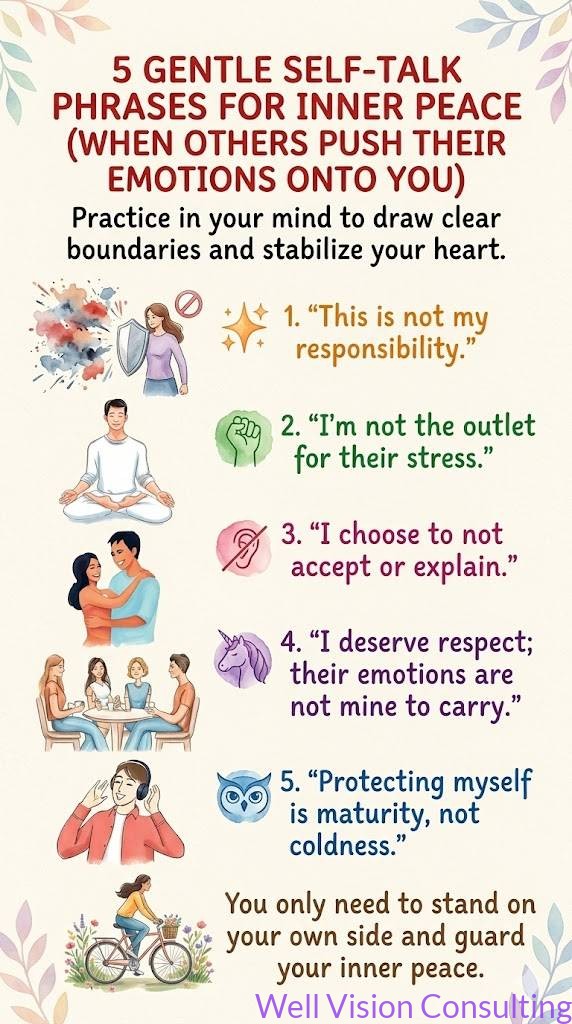
當別人把情緒推給你,你可以怎麼做?
有時候,明明知道那不是我們的錯,但還是被那一句話影響,開始懷疑自己。
🌿這時,你需要的是溫柔而堅定的「自我對話」。
請練習在心裡對自己說這幾句話
幫助你在穩住內心、劃清界線。
✦ 自我對話練習句 ✦
✨️「這不是我的責任,我可以不用負責。」
🥊「不是我的錯,我只是成了他情緒的出口。」
🙉「我選擇不接受、不解釋、不討好。」
🦄「我值得被尊重,不為他人的混亂情緒負責。」
🦉「保護自己不是冷漠,而是一種成熟。」
😊你不需要吵贏,也不需要說服誰。
❤️你只需要站在自己這一邊,好好守護自己內心的平靜。
心理學核心概念:
- 心理界線(Psychological Boundaries):
源自系統理論,幫助你區分自己和他人的責任,避免被情緒吞噬。 - 認知行為心理學(CBT):
透過認知重構,挑戰負面想法,如「我沒有做錯什麼」,減少內耗。 - 自我關懷(Self-Compassion)by Kristin Neff,鼓勵以溫柔對待自己,增強心理韌性。
- 情緒調控(Emotion Regulation byJames Gross模型,重新詮釋情境,穩住內心平靜。
- 責任轉移與投射(Projection):
辨識他人情緒投射,拒絕不屬於你的負擔。 - 復原力(Resilience)
透過正向自我對話,面對壓力時更堅強。
這些方法有心理學依據,還能在日常中運用,守護我們內心!
願景諮詢邀請大家在生活中試試這些自我對話,感受小練習累績帶來的大改變吧~
圖片來源:AI生成
如果這篇內容對你有幫助,歡迎點擊下方分享,讓更多人看見 🌿
5 Gentle Self-talk for Inner Peace
When Others Push Their Emotions onto You, What Can You Do?
Sometimes, even when we know it’s not our fault, we are still affected by a single comment and begin to doubt ourselves.
🌿 At these moments, what you need is a gentle yet firm “Self-Talk” practice
Try practicing these phrases in your mind to help stabilize your heart and draw clear boundaries.
✦ Self-Talk Practice ✦
✨ “This is not my responsibility; I don’t have to take it on.”
🥊 “It’s not my fault; I have simply become an outlet for their emotions.”
🙉 “I choose not to accept, not to explain, and not to people-please.”
🦄 “I deserve to be respected; I am not responsible for others’ chaotic emotions.”
🦉 “Protecting myself isn’t being cold—it’s a sign of maturity.”
😊 You don’t need to win an argument, nor do you need to convince anyone.
❤️ You only need to stand on your own side and guard your inner peace.
Core Psychological Concepts:
- Psychological Boundaries: Derived from systems theory, this helps you distinguish between your responsibilities and those of others, preventing you from being consumed by external emotions.
- Cognitive Behavioral Therapy (CBT): Uses cognitive restructuring to challenge negative thoughts (like “I did nothing wrong”), reducing internal exhaustion.
- Self-Compassion (by Kristin Neff): Encourages treating yourself with kindness to enhance psychological resilience.
- Emotion Regulation (James Gross’s Model): Reinterpreting situations to maintain inner calm.
- Blame-Shifting and Projection: Identifying when others are projecting their feelings onto you and refusing to carry a burden that isn’t yours.
- Resilience: Strengthening your ability to face stress through positive self-talk.
These methods are grounded in psychology and can be applied in daily life to protect our hearts!
Give these self-talk phrases a try and feel the change happen.
Image Source: AI Generated
If this resonates with you, feel free to share it using the buttons below.