
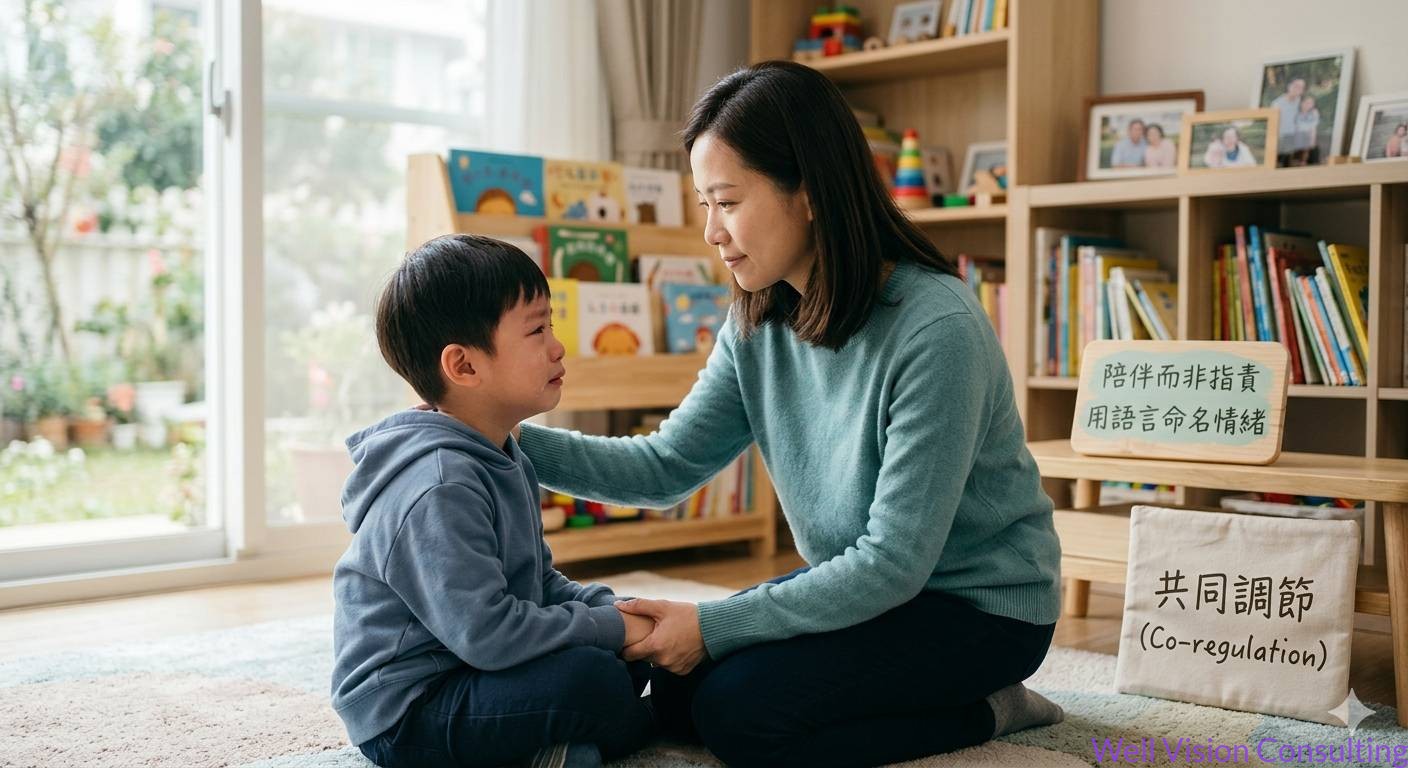
孩子情緒失控時,單純告訴他「冷靜點」通常沒用,因為大腦在強烈情緒下需要先被安撫,才能恢復理性思考(Sroufe, 1996; Perry, 2006)
情緒調節能力是透過大人穩定陪伴與安撫,慢慢內化成孩子自己的技能。
什麼是共同調節(Co-regulation)
大人幫助孩子穩定情緒的過程,稱為共同調節(Sroufe, 1996)
近年研究持續證實,父母的共同調節對孩子情緒發展至關重要(例如 Northrup 等, 2025;多項縱向研究)
具體做法:
- 陪伴而不是指責
- 不催促、不批評
- 坐在孩子身邊,用平穩語氣陪伴
2.用語言描述情緒(命名情緒)
- 「我看到你很生氣/很難過」
- 「你現在很失望,因為玩具壞了,對嗎?」
3.協助孩子冷靜
- 一起深呼吸、輕拍背、握手
- 提供安全空間,讓孩子慢慢恢復平靜
這樣能幫助孩子的大腦從「戰或逃」模式回到平衡狀態(Porges, 2011)
建立安全感與依附
依附理論指出(Bowlby, 1969; Ainsworth et al., 1978):
穩定陪伴 + 理解情緒 → 孩子安全感提升
安全依附的孩子情緒更穩定,社交能力也更好,較少長期情緒困擾
父母實務做法:
- 固定日常陪伴時間(睡前故事、共讀、一起吃飯)
- 對孩子情緒回應一致,不輕易忽略或責罵
情緒教養的三步驟(源自 Gottman 的 Emotion Coaching 情緒教養法)
- 理解情緒 — 先認同孩子的感受
- 幫助調節 — 先安撫情緒,再一起討論解決方法
- 行為引導 — 溫和設立界線,讓孩子知道哪些行為不可接受
例如:「我知道你生氣,我們先一起深呼吸冷靜一下,但打人不可以,我們可以用話說出來。」
最新研究支持(近年實證)
- 父母的情緒回應與陪伴,直接影響孩子的情緒調節發展(多項 2024–2025 縱向研究與 meta-analysis)
- 情緒調節能力較好的幼兒,同儕關係與社交接納度更高(2025 三層次 meta-analysis,Liang 等)
- 青少年期的情緒調節能力與憂鬱症狀呈現雙向影響,早期建立好基礎能降低風險(近期縱向研究)
願景諮詢給父母的重要提醒
- 先安撫孩子,再教規矩
- 用語言說出、認識及同理情緒
- 建立安全感與一致回應
- 保持溫和界線
這個過程需要時間與耐心。通常在 3–8 歲間,孩子會逐漸從「靠大人共同調節」轉向「自己調節」;即使到青少年期,父母的穩定陪伴仍然很重要。
孩子不是因為被要求「冷靜」而學會冷靜,而是透過被理解、安撫與引導,慢慢內化成自己的能力(Sroufe, 1996;近年多項研究支持)
從今天開始,試著在孩子情緒爆發時,先蹲下來陪伴、安撫,給一段時間與空間,再慢慢談規矩。
你會發現,孩子漸漸會變得更能自己冷靜下來~❤️
如果這篇內容對你有幫助,歡迎點擊下方分享,讓更多人看見 🌿
Children Learn to Calm Down Because Someone Calmed Them First
When a child loses control of their emotions, simply telling them to “calm down” is usually ineffective. Under intense emotional stress, the brain must first be soothed before it can regain the capacity for rational thought (Sroufe, 1996; Perry, 2006).
The ability to self-regulate is a skill that children gradually internalize through the steady presence and soothing of adults.
What is Co-regulation?
The process by which an adult helps a child stabilize their emotions is known as Co-regulation (Sroufe, 1996).
Recent studies continue to confirm that parental co-regulation is vital to a child’s emotional development (e.g., Northrup et al., 2025; various longitudinal studies).
Specific Actions:
- Presence Over Criticism
- Avoid rushing or criticizing.
- Sit beside the child and offer your presence with a calm tone.
- Label the Emotion (Naming It)
- “I see that you are very angry/sad.”
- “You feel disappointed because the toy is broken, right?”
- Assist in Calming
- Practice deep breathing together, pat their back, or hold their hand.
- Provide a safe space for the child to slowly regain composure.
This helps the child’s brain shift from “fight or flight” mode back to a state of equilibrium (Porges, 2011).
Building Security and Attachment
Attachment Theory (Bowlby, 1969; Ainsworth et al., 1978) points out:
Steady Presence + Understanding Emotions → Increased Sense of Security
Securely attached children exhibit more stable emotions, better social skills, and fewer long-term emotional difficulties.
Practical Steps for Parents:
- Establish consistent daily “connection time” (bedtime stories, reading together, eating together).
- Provide consistent responses to the child’s emotions; avoid ignoring or scolding them for their feelings.
Three Steps of Emotion Coaching (Based on Gottman’s Method)
- Acknowledge the Emotion :Validate the child’s feelings first.
- Assist in Regulation :Soothe the emotion before discussing solutions.
- Behavioral Guidance : Gently set boundaries so the child knows which behaviors are unacceptable.
Example: “I know you’re angry. Let’s take a deep breath together to calm down first. However, hitting is not allowed; we can use our words instead.”
Support from Recent Research (Latest Evidence)
- Parental emotional responsiveness and presence directly impact the development of a child’s emotional regulation (multiple 2024–2025 longitudinal studies and meta-analyses).
- Toddlers with better emotional regulation skills show higher peer competence and social acceptance (2025 three-level meta-analysis, Liang et al.).
- There is a bidirectional influence between emotional regulation and depressive symptoms during adolescence; building a strong foundation early can reduce future risks.
Core Message for Parents :
- Soothe the child first, then teach the rules.
- Label and validate the emotion.
- Build a sense of security through consistent responses.
- Maintain gentle boundaries.
This process requires time and patience.
Generally, between the ages of 3 and 8, children gradually transition from “relying on co-regulation” to “self-regulation.”
Even during adolescence, the stable presence of a parent remains crucial.
Children don’t learn to calm down because they were told to; they learn because they were understood, soothed, and guided, eventually internalizing these skills (Sroufe, 1996; supported by various recent studies).
Starting today, when your child has an emotional outburst, try to crouch down, offer your presence, and soothe them before discussing the rules.
You will find that bit by bit, they become more capable of calming themselves down. ❤️
If this resonates with you, feel free to share it using the buttons below.